Tracciamo Colori: Fossoli in Festa
The Challenge
How can a community begin to reimagine its public spaces together?
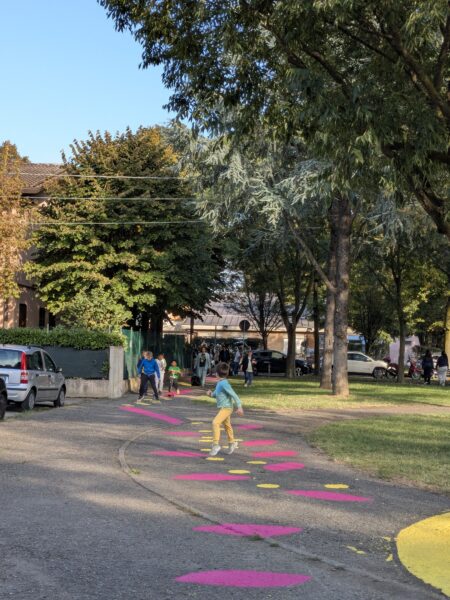
In Fossoli, a neighborhood of Carpi, residents expressed a desire for public spaces that felt more colorful, welcoming, playful, and safer for pedestrians and cyclists.
The challenge was therefore not only physical but also social: creating opportunities for residents to collectively imagine the future of their neighborhood while building an understanding of what could be achieved through a temporary intervention.
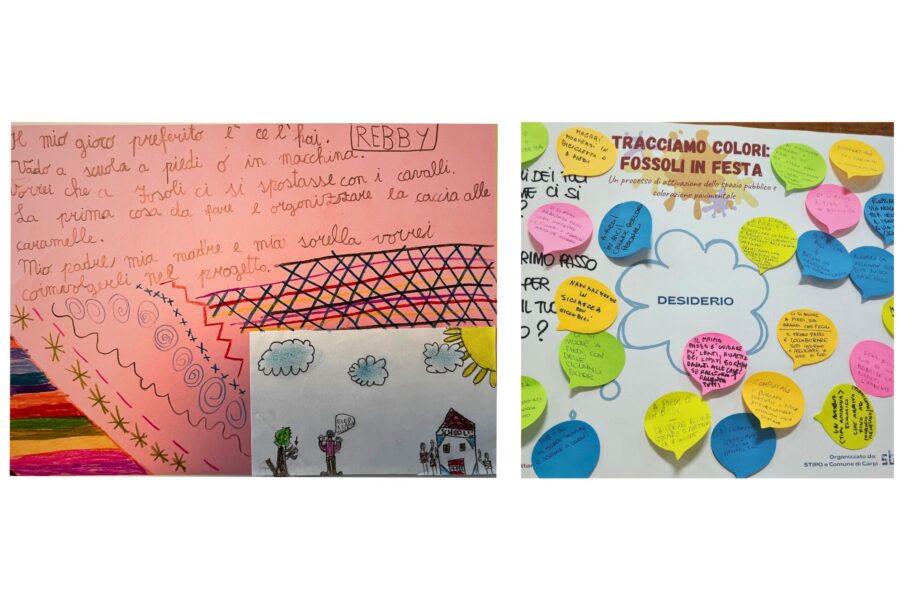
Through a series of engagement activities with adults and children, the project collected hundreds of contributions from the local community. Some of the findings revealed an interesting contrast: while 80% of children reported arriving at school by car, 60% said they would prefer to move around Fossoli by bicycle, and 20% on foot. Residents also expressed a desire for a neighborhood that felt more sociable and oriented toward everyday life in public space. These aspirations became the starting point for the project.
The Approach
STIPO Italia Cooperativa worked together with the Municipality of Carpi to design and facilitate a participatory process connecting local aspirations with tangible action.
In the months leading up to the intervention, residents of Fossoli — adults and children alike — were invited to share stories, memories, concerns, and wishes for their neighborhood. Across different engagement activities, the process gathered up to 350 contributions on topics ranging from play, mobility, and community life to dreams for Fossoli’s future.
Throughout the process, an important part of the work was not only listening but also discussing limitations. Residents raised questions about what could realistically remain over time, why the intervention would be temporary, and how future improvements might be developed. Rather than avoiding these conversations, the project embraced them as a fundamental part of participation. Together, we explored how temporary interventions can serve as experiments, allowing communities and institutions to test ideas before making larger investments.
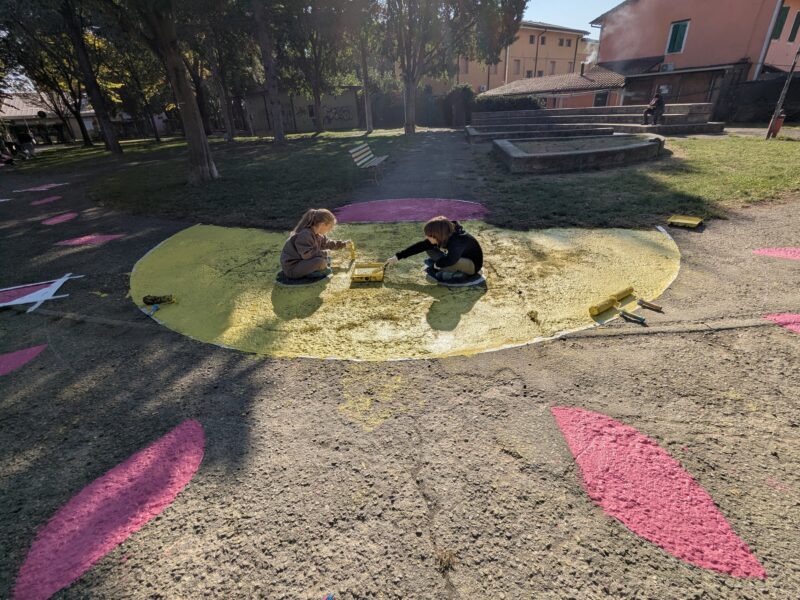
Out of this dialogue emerged the idea of a collective pavement mural: a temporary yet visible intervention designed to translate community aspirations into a shared experience in public space. The methodology combined participatory design, placemaking, tactical urbanism, and human-centered approaches, emphasizing low-cost and community-driven action as a catalyst for longer-term change.
Making the City Together
Tracciamo Colori was built through collaboration between residents, the primary school of Fossoli, local institutions, the Municipality, and STIPO Italia Cooperativa.
The Municipality of Carpi commissioned and supported the project, while residents of Fossoli actively contributed throughout the participation process. Children played a particularly important role, sharing their perspectives on mobility, play, and everyday life in the neighborhood. Teachers and educators from the local primary school helped bridge the process between the classroom and the public space.
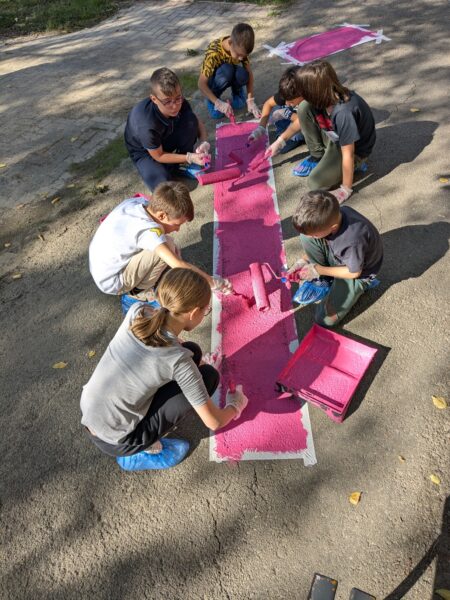
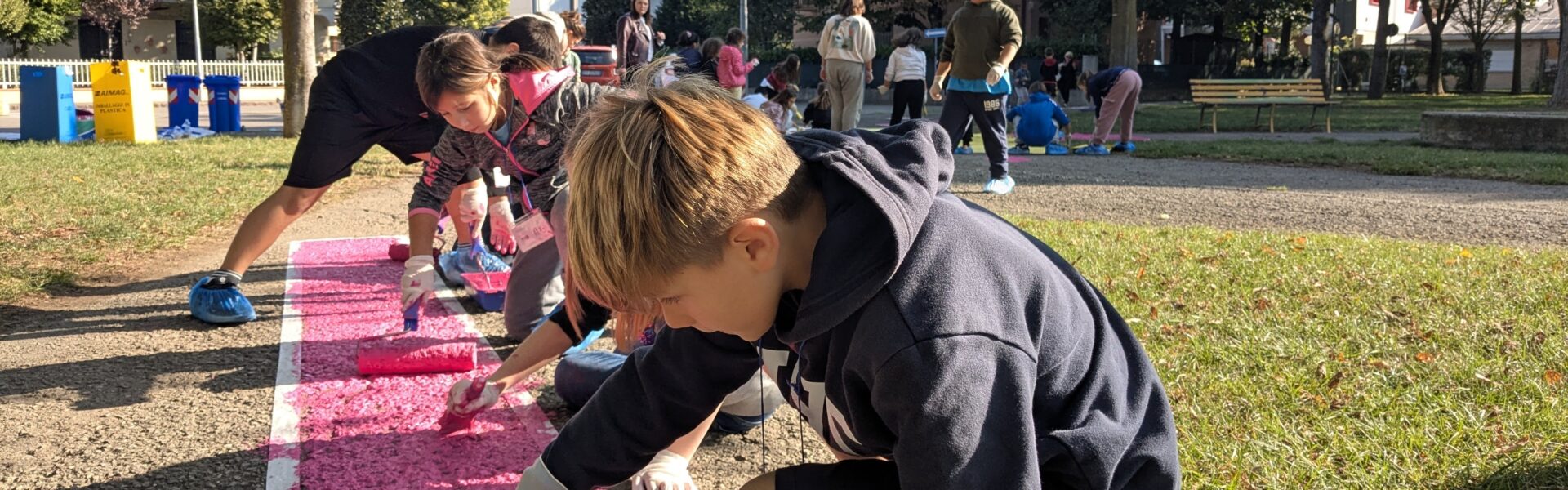
The participatory journey culminated in a collective coloring day involving 167 students from Fossoli Primary School. Together with the school teachers, Stipo Italia Cooperative members, and local stakeholders acting as facilitators of the process, they transformed part of the neighborhood through color, creativity, and collective action.
“Tracciamo Colori reminded us that participation is not a one-day event, but a long-term journey. Temporary interventions can spark imagination and connection, but lasting impact depends on continued dialogue, trust-building, and commitment from both communities and institutions.” — STIPO Italia
For STIPO Italia Cooperative, the project was also a reminder that meaningful city-making emerges through relationships. Participation is not something delivered to communities, but something built together through dialogue, trust, and shared responsibility.
Visualizing Impact
The most visible result of the project was a collective pavement mural created together with 167 students. Yet the project’s impact extends beyond the painted surface itself.
The engagement process generated hundreds of contributions from residents, helping create a richer understanding of how Fossoli is experienced today and how people would like it to evolve in the future. It opened conversations about mobility, safety, play, and public space while creating new connections between residents, the primary school, local institutions, and the municipality.
The coloring day transformed part of the neighborhood into a temporary space of collective action, offering participants a direct experience of how collaboration can foster care, responsibility, and pride in shared spaces. The mural itself may be temporary, but the relationships, memories, and conversations generated through the process have the potential to support future initiatives in Fossoli.
Vision for the City
One of the key lessons from Tracciamo Colori is that participation becomes most meaningful when imagination is connected to action.
Temporary interventions alone do not solve complex urban challenges. However, they can create the conditions for people to experience collective agency and test possibilities before making larger investments. In Fossoli, the mural was never intended as the final outcome, but as a first step in a longer conversation about the future of public space and mobility in the neighborhood.
The project also reinforced the importance of transparency. Meaningful participation requires discussing not only aspirations but also constraints, budgets, and limitations. When these conversations happen openly, temporary interventions can become powerful tools for building trust and strengthening relationships between communities and institutions.
For municipalities and practitioners, Tracciamo Colori demonstrates how small-scale placemaking interventions can activate public space, reveal local aspirations, and lay the foundations for longer-term transformation.